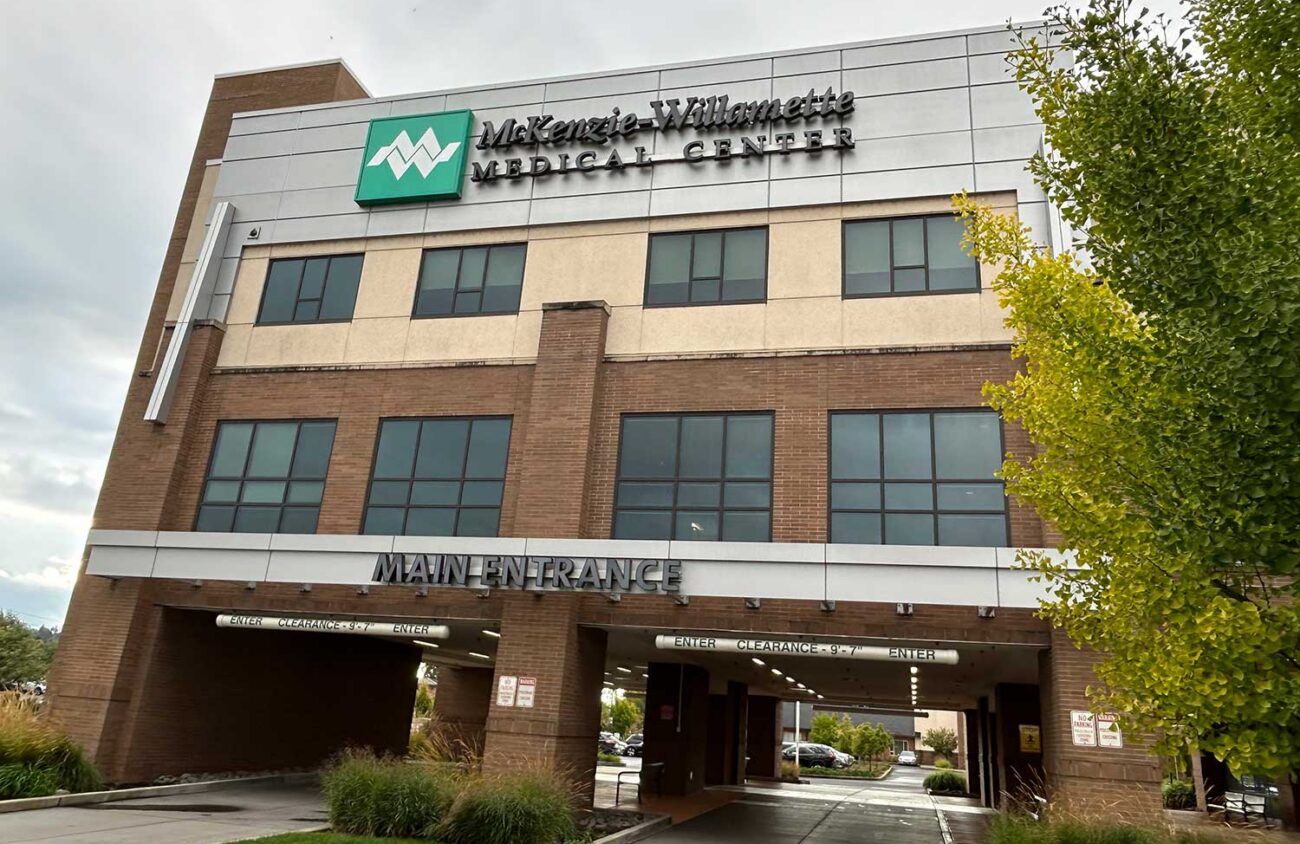
McKenzie-Willamette Medical Center is a big deal in Lane County.
It’s the region’s second-largest hospital. Last year, it handled nearly 60,000 emergency department visits. With 932 workers, it’s a major employer. It pays $1.7 million in property taxes a year to Springfield, the county and other jurisdictions on its $160 million Mohawk Boulevard campus.
And its future is way up in the air.
The hospital is part of the Tennessee-based for-profit Quorum Health chain, which operates 11 financially struggling small-to-medium-sized hospitals around the country. Quorum’s majority owner is New York-based private-equity giant GoldenTree Asset Management. GoldenTree has tried to sell the hospitals, but failed, partly because the hospital chain is burdened by a financially crippling $1 billion in high-interest-rate debt, much of it owed to GoldenTree itself.
Now, GoldenTree is proposing a radical and unusual reorganization of Quorum.
It wants to convert the chain into a nonprofit that would use its nonprofit status to refinance the debt with new lenders at lower interest rates — much like a homeowner might refinance a high-rate mortgage to get a lower rate and monthly payment.
The Oregon Health Authority is reviewing the plan to decide if it serves the public interest and should be approved.
The transformation would leave the newly minted nonprofit burdened with a ton of long-term debt — $1.26 billion — requiring it to pay out $105 million or more a year in interest to the lenders, Quorum’s filings with Oregon and California show.
But that interest payment would actually be less than Quorum’s current annual interest payment of about $136 million, Quorum says. That cost reduction would help revive all 11 hospitals, it says.
West Eugene Emergency Department
What does it mean for McKenzie-Willamette?
The hospital is financially weak. In 2025, it suffered an operating loss of $14 million on $273 million in operating revenues, following three years of barely breaking even on operations, its filings with the state show.
Under the reorganization, the hospital’s “existing leadership, employees, vendors, and day-to-day operations are expected to continue, preserving continuity for patients and the community,” Quorum told Oregon regulators.
Under a nonprofit structure, McKenzie-Willamette would have “increased opportunity to continue advancing” its plan to build a standalone $20 million emergency department in west Eugene, Quorum said in its filings. But Quorum gave no timeline or firm commitment. Eugene planning officials approved the project last spring. Since then, there has been no sign of progress.
“Funding of the [emergency department] project will be in jeopardy” if OHA denies the conversion to non-profit status,” Quorum told OHA.
One critic, a nonprofit watchdog group that monitors private-equity companies, is scathing about the proposed reorganization.
The proposal is GoldenTree’s way of continuing to milk the 11 hospitals for financial gain, says Jim Baker, executive director of the Chicago-based Private Equity Stakeholder Project. The state should reject the proposed reorganization because the 11 hospitals would emerge “heavily indebted.”
“GoldenTree Asset Management and other Quorum owners and lenders appear to be the main beneficiaries of the proposed transaction, relying on [the refinancing] to get a payout for Quorum hospitals they have been unable to sell,” Baker told regulators.
GoldenTree holds much of Quorum’s debt, on which GoldenTree receives hefty annual interest payments from Quorum, the filings show. With the reorganization, GoldenTree would get others to refinance Quorum and thereby let GoldenTree recoup what it is owed, Baker asserts.

No enforceable commitments
Marty Wilde, a Eugene attorney and former Oregon legislator, says it’s hard to evaluate the proposal because Oregon regulators won’t release to the public much of Quorum’s application. Wilde is one of the few area residents who have submitted comments to OHA.
As a nonprofit, McKenzie-Willamette would be able to offer more and better care, Quorum asserts in the application. But Quorum’s language is nebulous and does not quantify or provide timelines for any improvements.
“I did not see [in the application] enforceable McKenzie-Willamette-specific commitments on charity care, Medicaid access, staffing, local governance, or preserving particular services,” Wilde tells Eugene Weekly. “The conversion (to nonprofit) could help residents, but only if OHA makes the public benefits concrete and enforceable.”
Financial secrets
The OHA’s Health Care Market Oversight program has not yet said what level of scrutiny it will give the proposal. By Sept. 30, OHA expects to complete a preliminary review and decide whether to launch a “comprehensive” review, says OHA spokesperson Franny White. The agency could hold public “listening sessions,” appoint a “community review board,” or hold a public meeting where Quorum officials would answer questions, White says.
Oregon has among the toughest programs in the nation to vet health care transactions.
But OHA is letting Quorum black out many of the records put up for public view on OHA’s market-overview website. Quorum’s audited financial statements, its presentation to the OHA, its financial feasibility projections and management plan for the proposed nonprofit, and other key documents are omitted or blacked out. Citing Oregon law, Quorum claims they are confidential.
California regulators, who are also evaluating Quorum’s conversion plan, have publicly released Quorum’s full 189-page application, disclosing some of Quorum’s internal financials. Quorum has a single hospital in California.
The documents OHA won’t disclose are “the documents that will determine whether the transaction actually benefits the community, or is simply another way for [creditors] to get bailed out at public expense,” Wilde says.
It’s unclear what GoldenTree and Quorum would do if OHA rejects the proposal.
“Without the transaction, Quorum would eventually need to pursue restructuring alternatives,” Quorum spokesperson Nicole Edwards tells Eugene Weekly. She did not offer specifics.
Quorum’s financial filings show that high interest payments to GoldenTree and other creditors have continuously drained virtually all profits from the hospital chain.
Crushing debt
The situation has tangled roots.
In 2003, financially failing McKenzie-Willamette, at that time a nonprofit, was bought by investors on the hunt for profits. The hospital was absorbed into a for-profit chain that eventually became Quorum. At its zenith, Quorum owned about 40 hospitals nationwide. The finances were precarious, records show. To buy hospitals, the chain took on debt, then struggled to extract enough profits from the hospitals to make debt payments. To stay afloat, Quorum sold off all but 11 of its hospitals, the records show.
Chasing high returns, GoldenTree several years ago stepped in and bought a majority ownership stake in Quorum, and also became a major creditor to Quorum, holding much of the roughly $1 billion in debt that Quorum now owes, filings show. In effect, GoldenTree, by owning Quorum, can ensure the chain continues to make debt payments that flow to GoldenTree and other creditors. “The creditors and the owners are now substantially the same people,” Wilde says.
In 2024, for example, the 11 hospitals collectively reported a $39 million profit from hospital operations, on $900 million in operating revenue, the California filings show. But interest payments are counted separately from operations. Quorum that year had to make $161 million in interest payments to GoldenTree and other creditors, the filings show. That drove the 2024 bottom line down to a $126 million loss. In 2022 and 2023, the filings show Quorum paying a total of $194 million in interest to creditors.
To make the interest payments, Quorum had to borrow more from its creditors, the filings show.
Much of the debt is at 10.36 percent annual interest or more, filings show.
By refinancing as a nonprofit, Quorum could bring that down to around 8.25 percent, Quorum claims.
But the Chicago watchdog group asserts the newly minted nonprofit would be financially anemic.
Quorum’s projections show the nonprofit chain in its first year would have $1 billion in assets — such as accounts receivable, cash, hospital buildings and equipment — but $1.7 billion in liabilities, including long-term debt of $1.26 billion. Such a deeply negative balance sheet is “a clear example of insolvency rather than a more sustainable capital structure,” Baker writes.
Nonprofit tax edge
The nonprofit that would take ownership of the chain has already been created. It’s called QKA Health Corp. It’s an empty vessel, with no holdings. Quorum’s executive team would become its leaders, the filings say.
The nonprofit would borrow $1 billion on the municipal bond market, something nonprofit hospitals can do, but for-profit ones can’t. Under tax law, the lenders would be exempt from paying income taxes on the interest they received. So, those lenders would accept lower interest rates, Quorum says.
The plan shows QKA Health would use that $1 billion to pay off the debt Quorum owes to GoldenTree and other high-interest lenders.
The creditors would be paid at less than dollar-for-dollar, Quorum spokesperson Edwards says. She did not specify how much less.
The payoff “will replace Quorum’s current high-cost, short-term and otherwise challenged capital structure with lower cost and long-term municipal bonds, a financing structure designed for a nonprofit health system that will improve liquidity and permit greater reinvestment in operations,” Quorum told the OHA. As nonprofits, the hospitals could, for example, solicit charitable donations and get special discounts on pharmaceuticals, Quorum said.
“These initiatives are expected to transition [McKenzie-Willamette] from its current operating loss to profitability,” Quorum wrote. The company has given OHA a feasibility study on the proposed nonprofit system. Quorum says the document is confidential and has directed OHA not to release it.
BlackRock write-off
Would creditors embrace the chance to lend to QKA Health?
The financial weakness of most of the 11 Quorum hospitals is no secret in the hospital industry.
BlackRock, a leading private-equity company, for a time held a minority equity ownership stake in Quorum. Earlier this year, it wrote off that stake as worth exactly $0, BlackRock’s public filings show.
McKenzie-Willamette is important to Quorum. With 113 beds, it’s the chain’s third-largest hospital.
Pre-COVID, McKenzie-Willamette reported high profits that its owners syphoned off. But the pandemic, sharply rising costs for employees and for pharmaceuticals, and tight insurance reimbursement rates put an end to that — as at many hospitals nationwide.
Since 2020, McKenzie-Willamette has averaged just $3 million a year in profits on its health-care operations, the hospital’s filings with the state show. Could the proposed reorganization turn that around?
Wilde urges clinicians, patients and local officials to contact the OHA: Put the word Quorum in the message field and email: HCMO.info@oha.oregon.gov.
Find Quorum Health’s application to the Oregon Health Authority by searching the word “Quorum” at Oregon.gov/oha or go to Oregon.gov/oha/HPA/HP/Pages/089-Quorum-Healthside.aspx.
This story has been updated.