By Cheyney Ryan
The recent Nov. 3 elections suggest that the age of appeasing Donald Trump may finally be coming to an end. University administrators should seize this opportunity to rediscover the importance of free speech — and the apparently forgotten principle that defending the integrity of their institutions matters more than currying favor with the White House.
A starting point at the University of Oregon is abolishing its Orwellian “Demonstration Education & Safety Team.” This is the bureaucratic apparatus through which the administration said it monitored political demonstrations and subjected students to disciplinary proceedings on the pretext that they are making too much noise.
I first learned of it when a former student contacted me to say that her niece was facing disciplinary charges for a “noise violation” at a demonstration. I spend part of the year at Oxford University, so I was unfamiliar with the administration’s disciplinary regime.
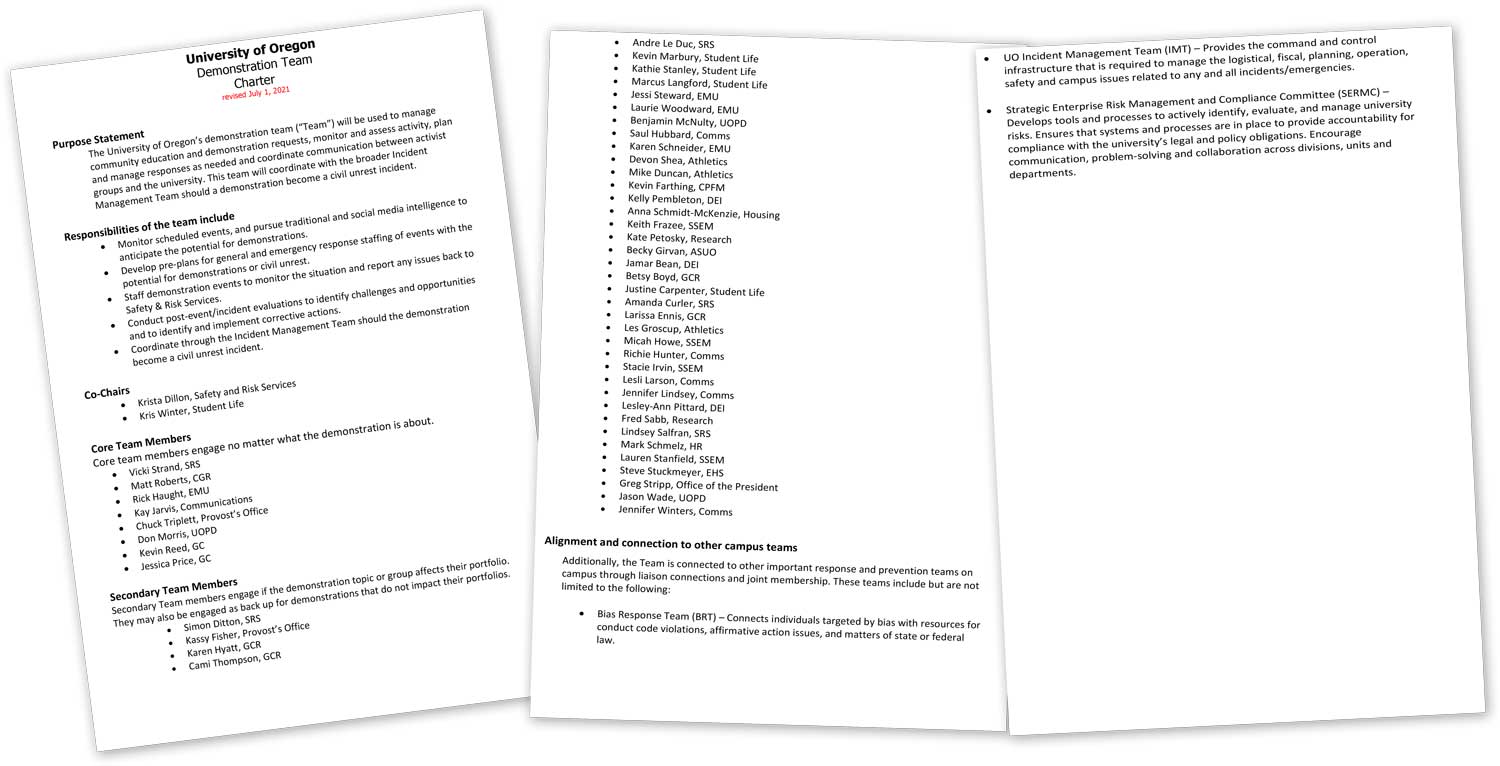
But a little digging revealed that no fewer than 51 university personnel had originally been enlisted in this effort — lawyers, police officers, risk-management officials, communications specialists and administrators from virtually every corner of the university. No teaching faculty, but three people from Athletics.
Their mission was to attend demonstrations, armed with smartphones equipped with the “Decibel X” app, ready to spring into action should the noise exceed 90 decibels — roughly the sound of a lawnmower. The university had painstakingly assembled this elaborate bureaucratic machinery to ensure that political protests would never be louder than the average vacuum cleaner.
I could hardly believe it. In more than 30 years teaching at the University of Oregon, through protests over the Gulf War, the Rodney King verdict and the invasion of Iraq, I cannot recall a single complaint about excessive noise. Quite the contrary. Protests were part of what made the University of Oregon a vibrant political community. Now, in the age of Trump, the university’s ideal of political protest was one that nobody could hear.
My skepticism about the university’s concern for noise comes from personal experience.
Last year, my wife Sandy Ryan and I returned to Eugene from Oxford to discover that the local fraternity was making our neighborhood nearly unlivable. Among other things, it had taken to installing loudspeakers on its basketball court and blasting chants of “Eat that pussy!” that could be heard blocks away. Neighbors were afraid to walk past the fraternity for fear of harassment.
Knowing the university’s keen concern about excessive noise, I contacted its Office of Community Relations.
The head of that office called and asked to come to our home to discuss the problem. When he arrived, his response was astonishing. “Cheyney, weren’t you young once?” he asked, as if terrorizing an entire neighborhood were just good, clean college fun. Then he warned us that if we continued complaining, we could face physical retaliation from the fraternity. He sounded less like a university official and more like a mob lawyer explaining the consequences of making trouble. I told him that if anything happened to Sandy or me, I would bring a RICO (Racketeer Influenced and Corrupt Organizations Act) action against him, the fraternity and 51 members of the administration.
My former student’s niece eventually received a “warning” for participating in a protest where the administration’s “monitors” outnumbered the protesters themselves. Despite warning Sandy and me about the possible retaliation from the fraternity, the administration has steadfastly refused to do anything about the threat — or about the fraternity’s continuing disruption of our neighborhood. Perhaps I should call the university and report that the fraternity boys are chanting “Free Palestine!” That ought to get some action.
Doesn’t the administration have better things to do than harass protesters, coddle fraternities and threaten professors? Instead of worrying about what Trump might think, it should return to thinking about what a university is for.
When Eugene Weekly reached out to fact check, the University of Oregon communications office said the Demonstration Education & Safety Team “concluded operations in fall 2025.” However, there had been no official announcement that the DEST had ceased. The UO says that “while there is no direct replacement for DEST currently, there is a procedure to respond to reports of policy violations or safety concerns.”
Cheyney Ryan is emeritus professor of philosophy and law at the University of Oregon and a senior research fellow at the Institute for Ethics, Law, and Armed Conflict at the University of Oxford.