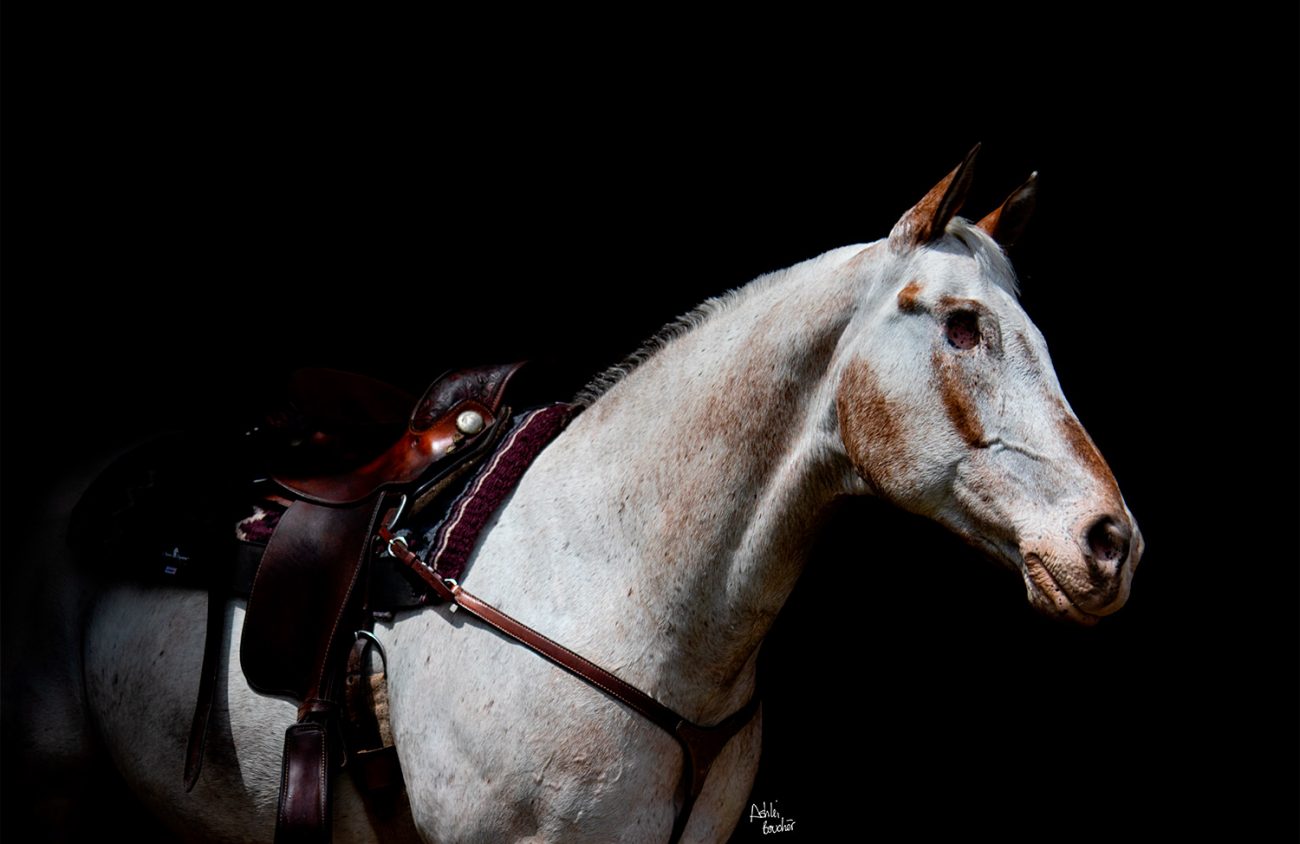
Endo the Blind meanders over to the fence on the far side of his indoor arena in Springfield. The horse doesn’t have any eyes, but senses where the fencing is and notices if the gate is open. Endo can even tell when there is a pole on the ground.
“I don’t know how he does that,” says Morgan Wagner, his trainer. When he first went blind, Wagner wasn’t sure if she could ever ride him again.
She was able to ride, and more. The 20-year-old appaloosa goes on trails, jumps and competes — just last year becoming a national champion in working equitation. He wasn’t always blind, and the impressive abilities and skills he’s learned since losing his eyes have garnered recognition and fascination from horse-lovers around the country.
Wagner was 13 when her grandma told her to pick out a horse, so she picked Endo, a few-months-old colt. She didn’t know much about horses at the time, but after learning how to put the halter on she worked her way up to riding Endo.
When Endo was 8, Wagner noticed his eyes started getting weepy and that he was in pain. The vet diagnosed him with equine recurrent uveitis, glaucoma and cataracts. Wagner was given medicine to administer and did her best to mitigate her horse’s pain, but his condition continued to worsen.
As Endo’s pain progressed Wagner’s vet helped her make the decision to fully remove one of his eyes. He would have eventually gone blind anyway. Though he was fearful at first, Wagner gently helped him adjust to his new condition, but she knew they were still on borrowed time for when the second eye needed to come out.
And six months later, it did.
“One thing I did not expect is that when he had one badly damaged eye still left he could see light and dark, which helped him maintain his balance,” Wagner says. “When he became completely sightless, he was stumbling around, and we had to do some therapy work.”
Wagner had looked for resources for training blind horses, but found nothing. She had to find the right methods with trial and error. Endo slowly learned how to be a horse again with Wagner’s diligent training, transforming visual cues into verbal ones.
It also helped that Endo had a companion — a 29-inch brown miniature horse named Cinnamon. When Endo was going blind, Wagner rescued the neglected miniature so Endo would have a buddy.
Wagner lets Endo out of his stall and into the arena. He walks up next to her with as much confidence as if he could see where she was standing.
“Endo, rear,” she says. And the horse stands up on his hind legs.
“Lay down,” she says. Endo folds up his legs and lies down on the ground.
Those commands and relearning spatial awareness took more than a year of repetition and training to get down. Eventually, he was proficient enough to compete. Now, he can do everything a sighted horse can do.
“The only issue I have is that he’s opinionated and likes to go fast,” she jokes. She adds that Endo likes to be the leader of the group during a trail ride, a trait she thought would go away with blindness.
But Endo was strong and resilient.
“I think that’s made him who he is, too.”
For more information about Endo or to contact Morgan Wagner about getting a horse trained email Morgan@EndotheBlind.com or visit Facbeook.com/EndotheBlind.
A Note From the Publisher

Dear Readers,
The last two years have been some of the hardest in Eugene Weekly’s 43 years. There were moments when keeping the paper alive felt uncertain. And yet, here we are — still publishing, still investigating, still showing up every week.
That’s because of you!
Not just because of financial support (though that matters enormously), but because of the emails, notes, conversations, encouragement and ideas you shared along the way. You reminded us why this paper exists and who it’s for.
Listening to readers has always been at the heart of Eugene Weekly. This year, that meant launching our popular weekly Activist Alert column, after many of you told us there was no single, reliable place to find information about rallies, meetings and ways to get involved. You asked. We responded.
We’ve also continued to deepen the coverage that sets Eugene Weekly apart, including our in-depth reporting on local real estate development through Bricks & Mortar — digging into what’s being built, who’s behind it and how those decisions shape our community.
And, of course, we’ve continued to bring you the stories and features many of you depend on: investigations and local government reporting, arts and culture coverage, sudoku and crossword puzzles, Savage Love, and our extensive community events calendar. We feature award-winning stories by University of Oregon student reporters getting real world journalism experience. All free. In print and online.
None of this happens by accident. It happens because readers step up and say: this matters.
As we head into a new year, please consider supporting Eugene Weekly if you’re able. Every dollar helps keep us digging, questioning, celebrating — and yes, occasionally annoying exactly the right people. We consider that a public service.
Thank you for standing with us!

Publisher
Eugene Weekly
P.S. If you’d like to talk about supporting EW, I’d love to hear from you!
jody@eugeneweekly.com
(541) 484-0519