
If you’re eager to get a head start on summer in the Cascades, stroll through the wildflower meadows of Tire Mountain, an often overlooked peak near Oakridge where the blooms of summer arrive by early June. The easy path contours two miles through sunny meadows with views of Cascade snowpeaks. Then the trail climbs through forest to Tire Mountain’s former lookout site.
The first 1.2 miles of the route is popular with mountain bikers, who then peel off to the left and zoom down the steep Alpine Trail to Westfir. Although bicycles are allowed on the rest of the Tire Mountain Trail, hikers pretty much have the meadows there to themselves.
Tire Mountain is named for Tire Creek, where a traveler on the old military wagon road to Oakridge left a broken wagon wheel.
To find the trailhead, drive Interstate 5 just south of Eugene, take exit 188A, and follow Willamette Highway 58 east for 30 miles, almost to Oakridge. Opposite the Middle Fork Ranger Station, veer left at the Westfir exit for 0.3 miles. At a T-shaped junction just beyond a bridge, turn left toward Westfir for 1.8 miles to a stop sign beside a covered bridge. Continue straight 4.5 miles on paved Aufderheide Road 19, turn left on National Forest Road 1912, a gravel road, for 6.8 steep, winding miles to Windy Pass, go straight onto road 1910 for 0.3 miles, and finally fork right onto road 1911 for another 0.4 miles to the “Alpine Trail” sign on the left.
No parking permit is required. Space can be a little tight, with cars left by both hikers and bikers.
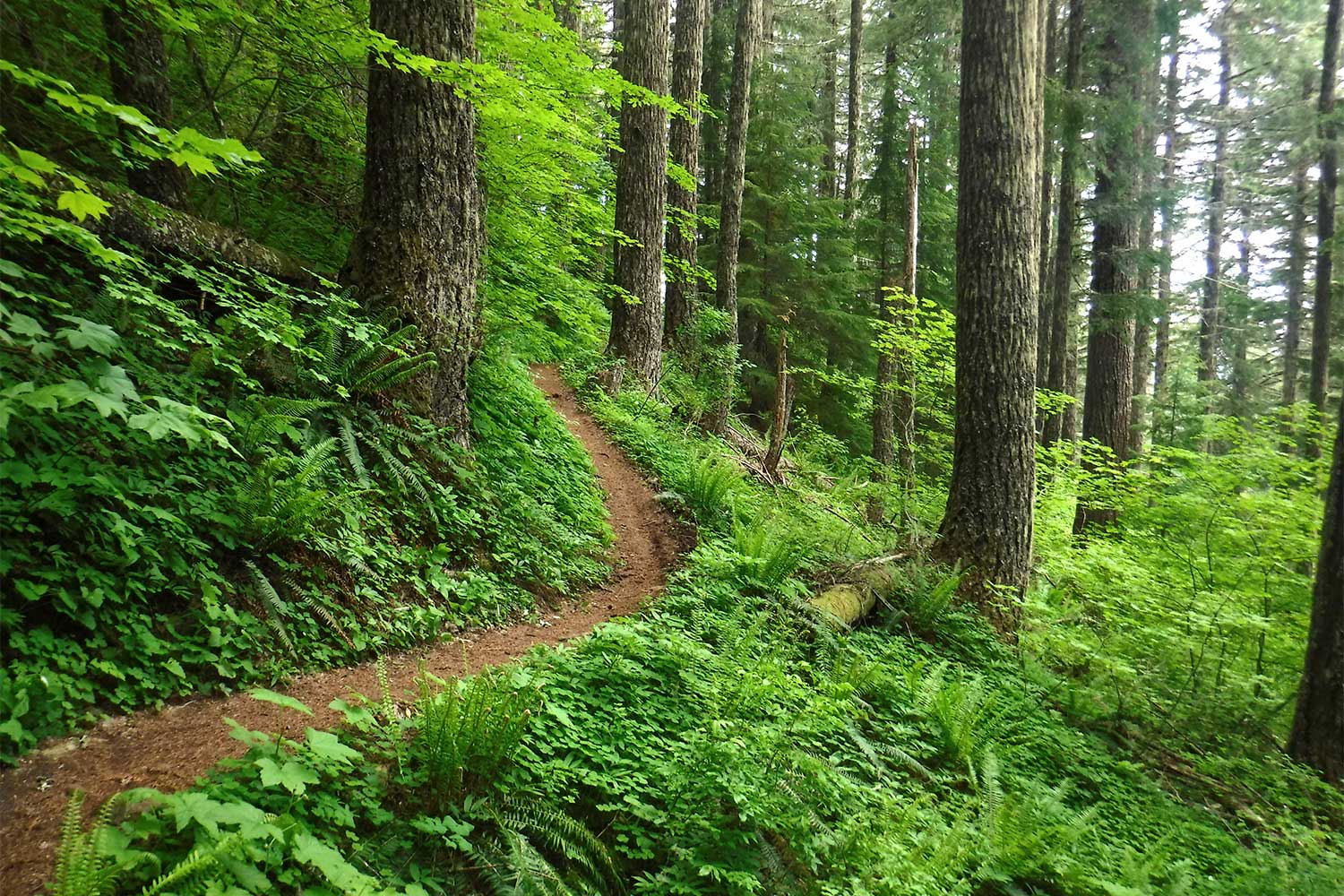
After a few hundred yards through second-growth woods, the trail enters a lovely old-growth forest packed with woodland blooms. Look for twin fairy bells, pink bleeding hearts, yellow wood violets and five petaled candyflowers. In another half mile the path traverses the first of a series of steep meadows. Diamond Peak dominates the skyline to the right, while Mount Bachelor and two of the Three Sisters cluster to the left. Below are Hills Creek Reservoir and the oak-dotted ridges of Oakridge, surrounded by clearcuts.
At the 1.2-mile mark, keep right at a trail junction in a summer patch of tall purple larkspur. The path ducks into the forest for half a mile and crosses two small meadows before emerging at the last and largest field, a slope that is covered each June by a carpet of tiny pink plectritis wildflowers.
If you’ve ever read the Dr. Seuss book Horton Hears a Who!, you’ll recognize plectritis as a probable model for the book’s seemingly endless fields of pink, ball-shaped flowers. In the children’s book, Horton the elephant discovers an entire civilization of tiny Whos on one of the tiny flowers, but then loses it amidst the rest.
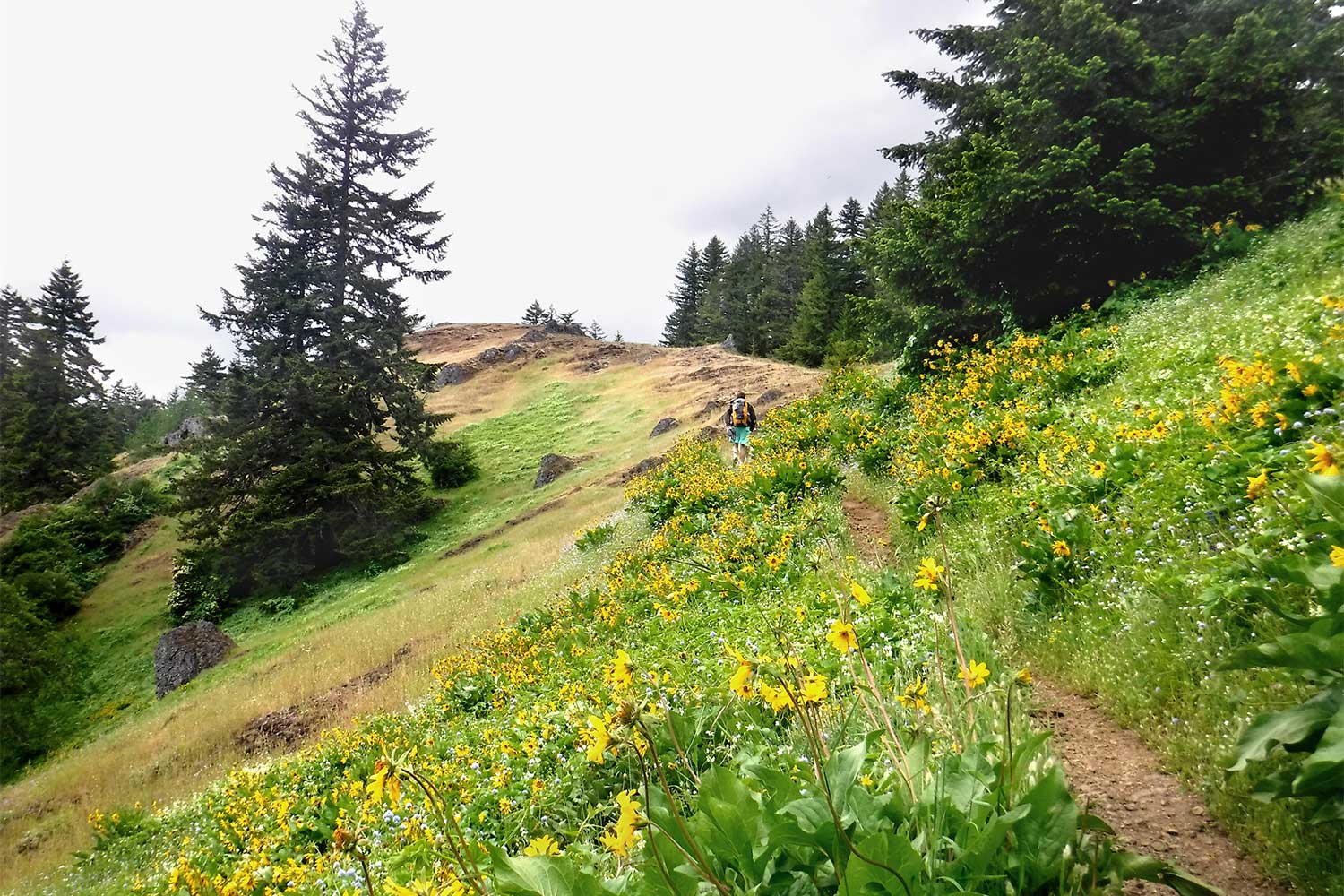
Amidst this plectritis field you can also expect to see yellow monkeyflower, sunflower-like balsamroot and blue camas.
If you’re tired, turn back at this final meadow. Otherwise, follow the virtually level path 1.1 miles through the woods to a trail junction on the slope of Tire Mountain. Take the uphill, left-hand fork, switchbacking to the broad, brushy summit. A few boards remain from the lookout tower that once stood here. The lookout was an early, simple design, a platform built atop a cut-off tree trunk in the middle of the summit field.
Trees now block much of the view from the summit, but a trip to Tire Mountain isn’t about conquering a peak. It’s about reveling in the glories of summer in the Cascades.
William L. Sullivan is the author of 23 books, including The Ship In The Woods and the updated 100 Hikes Series For Oregon. Learn more at OregonHiking.com.