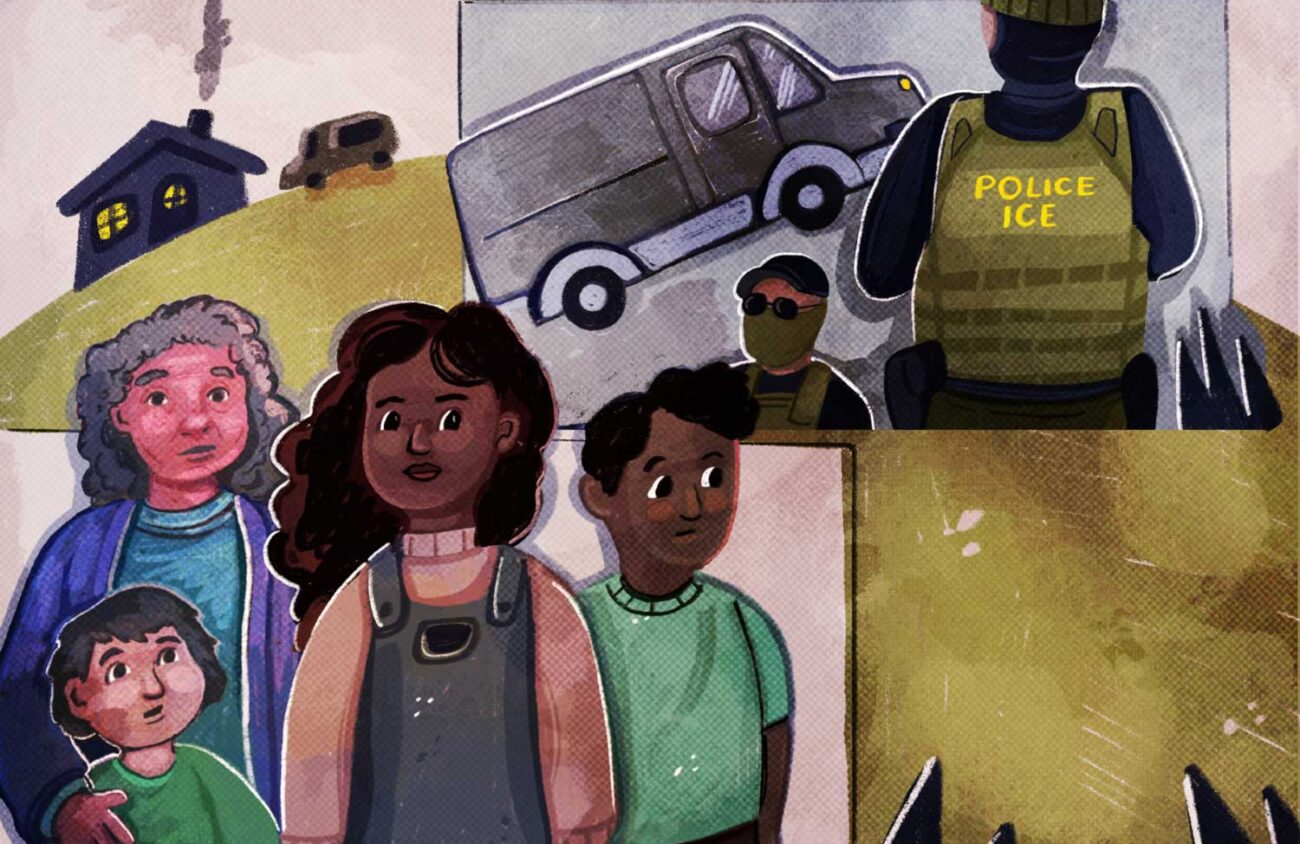
On the evening of Nov. 6, the Lane County Immigrant Defense Network held a nearly two-hour-long “emergency organizing meeting,” covering topics from protesting, to spotting ICE, to learning how to help those affected. This came after several community members from Eugene and Cottage Grove were detained by United States Immigration Custom Enforcement on Wednesday, Nov. 5.
It is unclear the exact number of people who were detained by ICE. But according to LCIDN organizers, all detainees were transported to Tacoma, Washington, and their legal teams from Equity Corps of Oregon are aware of their detentions.
The Lane County Immigrant Defense Network is an organization that engages in organizing tactics for immigrant defense, including community outreach and mass mobilization.
Around 250 concerned community members packed into the First Christian Church chapel in downtown Eugene.
Rob Fisette, an organizer for LCIDN, describes last Wednesday’s detainments as “unique” and “an escalation” of President Donald Trump’s immigration enforcement tactics. Organizers held the emergency meeting to respond to those tactics, he says.
“People are ready to act, to take personal political action, to try to defend the community,” Fisette says. “So we wanted to be here to have that vehicle available to them and give them the information they need to get involved.”
Colin Downey, community member and member of the Party for Socialism and Liberation, says he came to the meeting because it’s important for him to help people.
“I don’t like seeing what I’m seeing. I’m actually very offended by it,” Downey says. “It’s part of my duty as a human being to do what I can to help.”
Downey says that the Nov. 5 detainments were “personal” to him because he grew up surrounded by people from around the world.
“My history has involved a lot of foreign exchange students and getting to know them. It’s a gift to learn about their culture,” he says, “and learning that they’re the same and they’re not any different, even though they’re a different color, race or creed.”
Spotting ICE
Fisette says that since Oregon is a sanctuary state, meaning it has the right to stop state and local law enforcement and government from helping federal authorities with immigration enforcement, Oregon is being targeted by the Trump administration.
Attendees were told to ask themselves if they are encountering local or federal authorities. In order to determine non-federal authorities, they said to look for a yellow “E” license plate, indicating it’s a publicly owned car in Oregon, marked cars and whether the vehicle is heavily tinted or not, which they said federal cars tend to be.
Local authorities “tend to have a lot of cop gear and equipment in the front seat, dashboard cameras, a center console laptop, a rifle rack between the driver and the passenger side — feds don’t have that,” organizers said. “Those interiors, especially in unmarked cars, are relatively empty.”
But they also said to be aware that federal authorities change license plates.
They said that the vast majority of local and state authorities will not be masked and are willing to share information.
Attendees were advised to keep a look out for the U.S. Forest Service because they were allegedly involved in the Cottage Grove detainments. “They stopped people and held them until ICE got there,” organizers said. “Every federal law enforcement agent in the country is facilitating ICE raids; treat all of them with the highest level of suspicion and the highest level of risk.”
Organizers advise attendees to call the Portland Immigrant Rights Coalition hotline at 888-622-1510 if they spot ICE in their community.
How to protest legally
Lauren Regan, executive director and senior staff attorney of the Civil Liberties Defense Center, gave advice on how to protest in a legal and peaceful way.
She started with reminding attendees of their basic rights, including the right to remain silent, withhold consent to a search and ask for an attorney.
Regan said the Trump administration fast-tracked the implementation of new conduct regulations on federal property.
“It was supposed to take effect in January of 2026,” she said, “but it took effect midnight [Nov. 6] last night.” The new regulations allow the federal government to have jurisdiction of public forums, including public sidewalks, roadways, national forestlands and traditional areas where First Amendment activities would take place, Regan says.
Some of the activities prohibited on federal property, according to Regan, include littering, damaging or otherwise changing the appearance of federal property, removing federal property without permission, creating a hazardous threat in federal property, throwing articles of any kind, climbing on anything on federal property and using a personal transportation device.
She said some of the prohibited conduct on federal property also includes assaulting, fighting, harassing, intimidating, threatening or other violent behavior, as well as wearing a mask or hood while committing a crime, creating loud or unusual noise and obstructing federal property.
How to help
Organizers told attendees that they could donate to La Resistencia, a grassroots organization led by undocumented immigrants and people of color, and the Northwest Immigrant Rights Project, an organization that promotes justice by defending and advancing the rights of immigrants, to help fund the first $20 of detainees phone call fees.
Community members can also participate in LCIDN’s initiative in creating neighborhood patrols and canvassing and monitoring the Federal Building in Eugene.
To donate to La Resistencia, visit LaResistencianw.org/donate. To learn more about LCIDN, visit Tinyurl.com/ImmigrantDefenseToolkit.