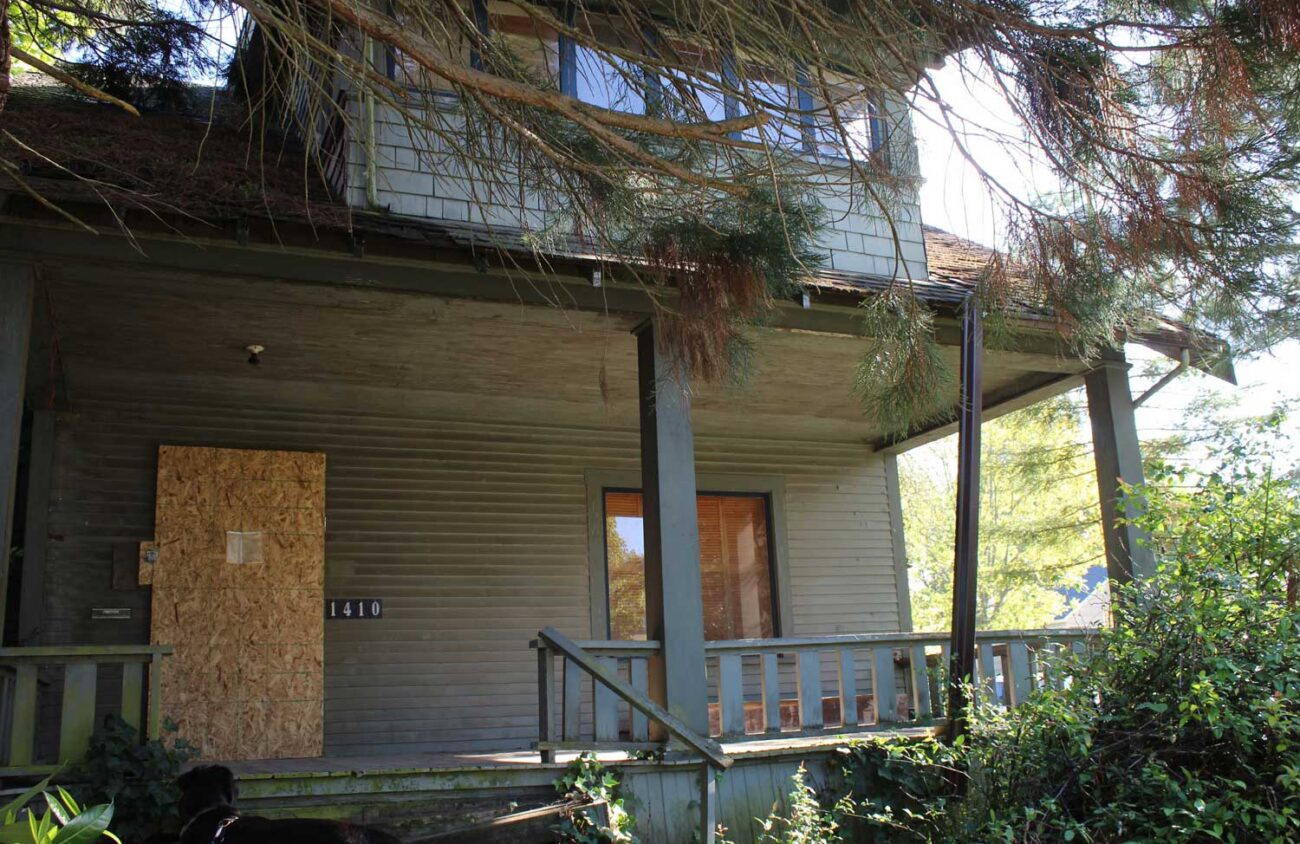
After a member from the South University Neighborhood Association knocked on Esther Celis’ door, informing her the property next to her was for sale, Celis wanted to find a way to stop the property from potentially being sold to a developer.
Celis was not an active member of SUNA, and says she still isn’t. But the knock on the door ignited her mission to prevent the neglected house, located on the southeast corner of 20th Avenue and Emerald Street, from being turned into apartments.
Built in 1920, the four-bedroom two-bath, two-story home sits on a nearly 8,000 square foot corner lot just two blocks away from the University of Oregon. Trees obscure the house’s boarded windows and mangled front porch.
Once members of the South University community got word of the property sale, a group of around 10 people rallied together to put in an offer to the seller, with the hope to purchase the property. Each member put down around 10 percent of the $260,000 asking price. The mission was to save the property stems from concerns of new development in the neighborhood.
According to Celis, the owner did not accept the offer from the group of community members.
After days of email conversations among SUNA members and finding a way to save the property, SUNA sent out an “Neighborhood Alert” newsletter to neighborhood subscribers April 22, calling for the “Urgent Need for Community Investment.”
“To have any agency over what happens on these properties it is critical that they be purchased by a community-invested neighbor or group of neighbors before they fall into the hands of outside speculators,” the newsletter reads.
SUNA, the elected board that represents the surrounding area residents, says in the newsletter that “there is a real risk that the buyer intends to scrape the lot, including fruit trees, and build the maximum allowed under current law.”
The property is listed for $260,000 and according to the newsletter, there was a cash offer from an unknown buyer and at least one additional offer as of April 22.
In the effort to prevent the property from being sold to a developer, the newsletter called on the South University community to join an established group of 10 neighbors, who have chipped in 10 percent or more of the asking price, to help buy the property. One of those neighbors is Celis.
“We are really making an effort to have some control … because we realized that the city planners, there’s nothing we can control there, apparently,” Celis says. “So, the only way for us to have an input would be to actually acquire it, and we would put it to use.”
The outcome of what the neighbors would do with the property, beyond turning down the neighbors’ offer, has not been decided yet according to Celis.
Celis says that the quick community action took place in the past week, as the seller was accepting offers until 10 am on April 27.
The concerns about the potential development stems from a recent multi-unit housing project on the corner of 22nd Avenue and Alder Street, Celis says.
“We just feel it is too much for the neighborhood, (it) doesn’t go with not just the historic landmarks of the neighborhood, but just in scale and aesthetics,” Celis says. “It’s just something we’ve never seen before in the middle of our neighborhood, and we are concerned that something like that could be built here on Emerald and 20th.”
David Rodgers, a neighbor across the street from the property, says that while he wouldn’t mind the idea of new development in the neighborhood, he would have concerns about the overall aesthetics of the development, especially after the development of the multi-story UO residence halls, located half a mile away from the property, coming fall 2027.
“But if a developer, that’s what bothers me, if they build it up too high, just like if the University of Oregon makes their new dormitories too high,” Rodgers says. “All of a sudden, you don’t have a sun, and it’s spiritually depressing.”
Rodgers also says that increased housing will make it so there will be not enough parking.
“I know they need housing, but how much housing do they need if you can’t drive to get to where you’re going because it’s too compact with all the cars, because of increased density,” he says.
The same higher-density housing that Rodgers refers to is what adjunct professor in the School of Planning, Public Policy and Management at UO Jesse Maldonado says is one of the only ways to help combat Eugene’s housing crisis.
“In Oregon, we’ve got this urban growth boundary, which keeps us from building out,” says Maldonado, who is also on the Lane Community College Board of Education. “So, our really only option is to build up if we want to do what we can to ensure that our neighbors have affordable and accessible housing and we can tackle the homelessness.”
Under Oregon law, all cities have an urban growth boundary, a UGB, which is where the city ends and resource lands start. When a city begins to run out of space to build housing in this boundary, it adds housing units by constructing fewer single-family dwellings and more higher-density units.
“Density is really the only option that we have versus sprawl, and we know sprawl is bad because it sucks up resources and creates more roads and emissions and it’s bad for the environment,” Maldonado says.
The construction of multi-dwelling developments up to three units is permitted in residential neighborhoods, but are limited to three stories above ground level.
Outgoing Eugene City Councilor Alan Zelenka, who represents the South University neighborhood, had not commented at the time of publication.