Sandwiched between the Willamette Valley and the high Cascades, the “old Cascades” — ancient mountains now eroded into cliffs and plateaus — offer some of the best hikes in the region, with diverse forests, views, wild streams and an explosion of wildflowers this time of year.
Popular trails lead onto some of these old peaks, like Rooster Rock, Iron Mountain and Three Pyramids. Rarer are trails in the valleys, but the Gordon Lakes trail offers mountain meadows and ancient forests nestled between steep cliffs. Streams that arise from these meadows include Falls, Boulder and Three Creeks, which in turn flow into the South Santiam River — a true scenic gem home to salmon and cutthroat trout.
To discover this tucked-away trail, make your way from Eugene to the town of Sweet Home via I-5 North and Hwy 228. Then, follow the South Santiam River upstream (east) along Hwy 20 on the aptly-named “Over the River and Through the Woods Scenic Byway” another 27 miles.
Turn right on Forest Road 2044/Latiwi Creek Road. Follow this good gravel road past the entrance to House Rock Campground and another 5.25 miles. Turn right on Road 230 and follow 2.7 miles to the road’s end and the Gordon Lakes trailhead. You don’t need a permit to park here, but there also are no amenities.
The trail bisects the nearly 10,000 acre Gordon Meadows Inventoried Roadless Area that is currently protected from new incursions of roads and commercial logging by the 2001 Roadless Area Conservation Rule.
For now. A proposal to repeal this rule is on the table.
The trail first descends into a basin holding the twin Gordon Lakes through a spectacular old-growth forest. This is usually an easy stroll, but a recent storm toppled several giant trees which have to be climbed over or around until trail crews are able to clear them. The forest here is at the western edge of what was once known as the Millennium Grove — an expanse of forest at the headwaters of Three Creek pushing 1,000 years old. Much of this grove was clearcut in the 1970s and ’80s, as battles over old-growth logging were coming to a head.
After passing the lower lake and crossing the stream that connects the lakes, stay to the left and follow the trail west. You’ll gradually gain elevation as you hike through the ancient forest’s shade. Note the diverse mix of trees: smooth gray-barked silver fir, towering noble fir and delicate Western hemlocks. But it’s the gigantic Douglas-fir trees, hundreds of years old and now living legacies scarred by long-ago fires that really stand out. Parts of the trail are lined with woodland wildflowers and scattered shrubs, and you can catch periodic glimpses of Soapgrass Mountain (a basalt cliff) rising to the south.
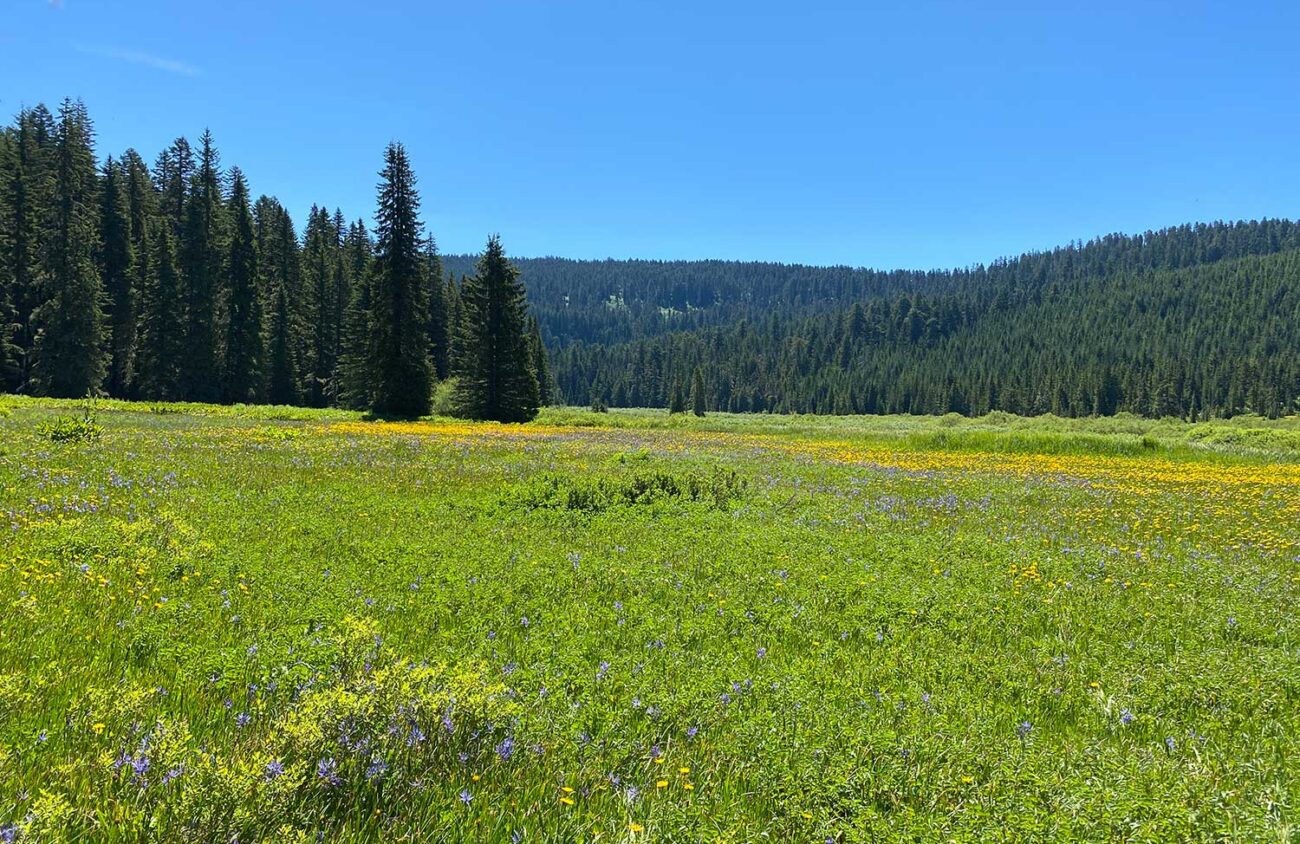
After about 2 miles, you’ll come across your first meadow, and at the 2.5 mile point, you’ll cross trickling Boulder Creek and get a view of the lush and tangled opening it flows through. Finally, at 3 miles, you’ll reach Gordon Meadows, filled with wildflowers throughout the month of June.
Head back when you’re ready. As you approach the lakes on the return trip, look for a trail to the left. This descends steeply and loops past the upper lake before reaching the little bridge that leads back up towards the trailhead.
If you were hoping for a place to swim and Gordon Lakes disappoint in that department, I recommend a sidequest to a great swimming hole on the South Santiam at the House Rock Campground. Turn off Forest Road 2044 at the campground sign and follow to a parking area just before a bridge and the campground entrance. Follow an obvious path towards the river to find the swim spot between a giant boulder and footbridge. You can also take the short and beautiful House Rock trail by crossing the bridge.
Want to help keep wild places like Gordon Meadows from damaging development and logging? An opportunity to weigh in on preserving the Roadless Area Conservation Rule is expected soon. Check out OregonWild.org/roadless for more background, how to comment, maps, and more suggested hikes.
Chandra LeGue of Eugene is the author of the book Oregon’s Ancient Forests: A Hiking Guide and is the senior conservation advocate at the nonprofit organization Oregon Wild.