You might think you know what to expect in advance of seeing Piecing it Together: a Regional Collage Exhibit, on view until July 17 at Maude Kerns Art Center. Collage is the result of gluing cut pieces of paper onto larger surfaces. It’s cut and paste, right?
Not necessarily. According to Ric Kasini Kadour, who is founder of World Collage Day and co-founder of Kolaj magazine, “Collage is an enormous tree.” This metaphorical definition is presented in the exhibit’s program and sets the tone for the show.
The idea that collage branches into a wide variety of media is embraced by the three judges who juried: Kellette Elliott, Beth I. Robinson and Judy Vogland. Artwork, selected from four states in the Pacific Northwest, adheres to traditional collage materials like paper, then extends to other media such as glass, digital photography, sculpture and more.
In the main room of the exhibit are multiple stand-alone sculptures, including “A Few of My Favorite Things” by Rs (Rocco and Carrie Rocco). An artwork in the shape of an extravagant table, it features more than a few objects, including a mask, eyeglass frames and a top hat.
Is a table a collage? It is here.
Whether “A Few of My Favorite Things” is most accurately defined as collage, sculpture or assemblage depends on one’s classification system, on which branch of Kadour’s tree you want to hang it on.
Of course, terrific examples of cut-and-paste hang on the walls, like Randy Derrick’s “1-888-Guys-Guys,” which is a portrait of a man whose head has bits of machinery coming out the top. Created with cut and pasted paper on cardboard, it pieces together a human face with tools; objects we’ve created to make work easier, yet this is not a portrait of anyone having an easy time.
You could say that’s the beauty part of collage, the reason the original Surrealists and Dadaists championed it as an art form. Taking pieces from different sources and pasting them into a new configuration or assemblage results in images that don’t necessarily make sense, but like dreams, can nevertheless be evocative.
The central figure in Lance Alton Troxel’s “Run Daphne Run” is also created by cutting and pasting and is similarly partly human, partly mechanical. The design uses type as a visual element and incorporates the frame. It is so dynamic that not only Daphne, but the whole picture, seems in motion.
Troxel identifies his media as “paper, ephemera, wood and glass.”
“Ephemera,” it turns out, is a word often used to identify media in collage. It’s the stuff we don’t expect to keep for long. Envelopes, coupons, receipts, advertisements, old keys or cards … things that might otherwise be thrown away are used by collagists to create art that might outlive them or even represent the culture in which they lived.
“My Enormous Heart” by Jennifer Giustina is constructed with recycled plastic, newspaper, anatomy and histology textbooks, masking tape, glue and papier mâché. Giustina describes this artwork as mȃché and collage.
Her heart is in the shape of an actual human heart, not the styled version we draw arrows through. It’s three-dimensional and covered with cutouts of anatomical illustrations like cells, lungs and DNA. Overall, the impression is far from an objectively drawn scientific representation, though. It’s large and pink, curious and emotional. Not to mention, you can barely say the title “My Enormous Heart” without conjuring up your own heart and feeling something about it.
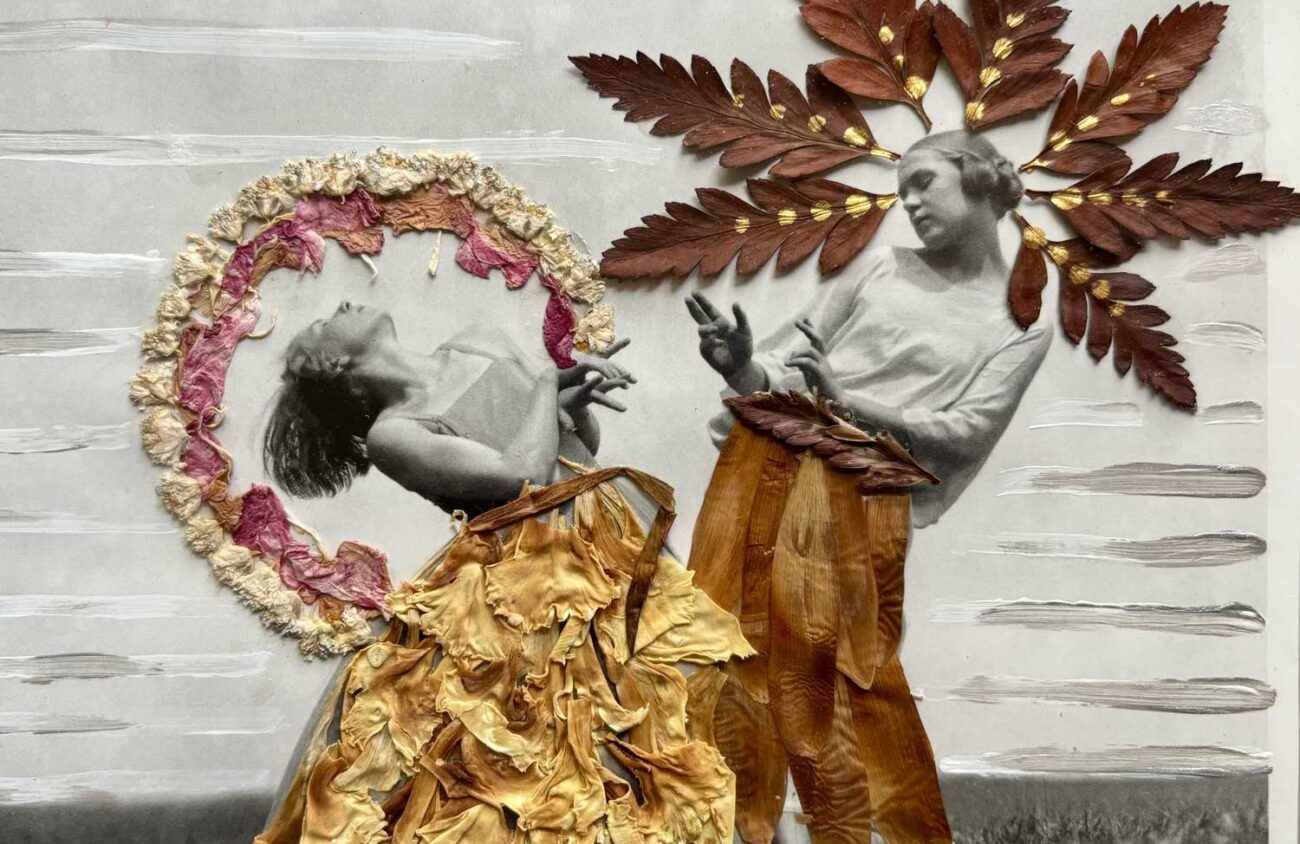
Eugene artist Sarah Rose’s “Protect Your Light: Sisters” is part of a series inspired by and incorporating pages from the book Women Seeing Women: A Pictorial History of Women’s Photography from Julia Margaret Cameron to Annie Leibovitz.
In her contribution to the show, Rose incorporates flowers, acrylic paint, and prints of two women. One woman seems to be taking a picture of the other, though there’s an empty space where she should be holding a camera. The machinery is implied and the dried flowers in the image are sourced from the artist’s own wedding day.
“Protect Your Light: Sisters” is at once academic, referring to a text about image making, and highly personal. It’s easy to see why Rose believes “collage creates community,” finding and being inspired by imagery made by others and merging it with our own.
Piecing it Together: a Regional Collage Exhibit is at Maude Kerns Art Center, 1910 East 15th Avenue, through July 17, Monday through Friday 10 am to 5:30 pm and Saturdays noon to 4 pm.