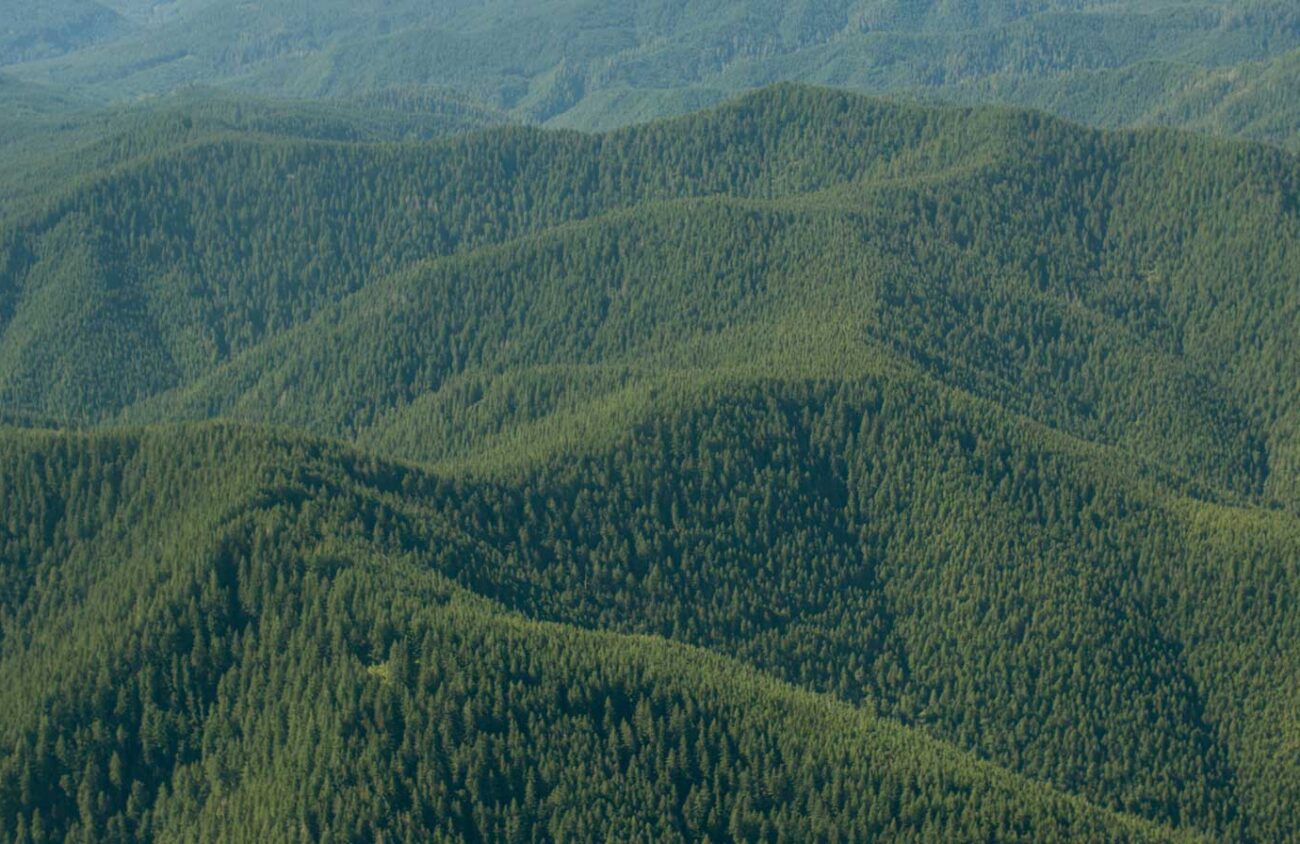
Trump’s U.S. Department of Agriculture secretary, Brooke L. Rollins, announced August 18 that the USDA Forest Service is moving forward with a plan to rescind the 2001 Roadless Area Conservation Rule. If rescinded, the change could open nearly pristine forests across the Pacific Northwest and nationwide to logging and increased human activity, including an area just 20 miles southeast of Eugene.
Environmental advocates say the consequences of rescinding the rule threatens the last remaining old-growth forests in the U.S. and will not prevent wildfires like the USDA claims.
“We’re seeing attacks on public lands from all angles. It is incredibly concerning just how aggressive and strategic they’ve been,” says Grace Brahler Newsome, wildlands director for environmental nonprofit Cascadia Wildlands. “The Trump administration is hell-bent on shutting out the American people from these lands, and how decisions are made on them, and really doing lasting damage.”
She adds that old-growth forests are resistant to wildfire, serve as a substantial carbon-sink, provide crucial habitats for endangered species and can help provide cleaner drinking water.
The USFS releases a draft environmental impact statement — a preliminary study on the impacts of proposed federal actions — August 19. Public comment on the proposal and draft EIS will open August 20 and be closed by Sept. 21.
Brahler Newsome says just 30 days for the public to review and comprehend the scope and scale of a change involving 45 million acres of public land is not enough time.
In an email to Eugene Weekly, the U.S. Forest Service press office writes, “USDA takes public involvement seriously, and today’s announcement reflects that commitment. When we opened the first comment period last fall, the Forest Service received more than 220,000 comments. That feedback directly informed both the draft environmental impact statement and the proposed rule announced today.”
The Roadless Rule currently encompasses approximately 44.7 million acres of land in the U.S. Brahler Newsome says repealing the rule could open these previously wild areas to aggressive forest management. In roadless areas, commercial logging is prohibited and road construction is highly regulated.
In Oregon, nearly 2 million acres are protected by the rule. Hardesty Mountain Roadless Area is the closest to Eugene. This area southeast of Eugene spans 8,000 acres between Hardesty Mountain and Mount June.
If the rule is rescinded, Chandra LeGue, senior conservation advocate of environmental nonprofit Oregon Wild says while there might not be an immediate effort to build roads and log in the Hardesty Mountain Roadless Area, new forest management plans could target it, alongside others. “That’s when we’re going to see the actual on-the-ground impacts,” she says, “which could mean more roads and more logging in older forests that have never been logged before and are currently providing some of the best hiking trails we have in the area.”
The USFS argues that, “repealing the Roadless Rule is more important than ever because 24.5 million acres of the Wildland Urban Interface, where forests meet communities, are either in roadless areas or within a mile of roadless — making increased access a major public safety issue.”
The Forest Service says rescinding the rule would not authorize more roads, but instead allow it to maintain and use roads that already exist. “The science is clear. Forests treated to reduce tree density and ladder fuels burn differently and with much less severity,” the USFS says in the statement. “A recent intensive review of over 40 case studies where wildfire burned into areas with previous forest treatments found overwhelming evidence that thinning, coupled with prescribed burning or pile burning, can reduce future wildfire severity by more than 60 percent relative to untreated areas.”
Timothy Ingalsbee, executive director of Firefighters United for Safety Ethics and Ecology says the idea that logging equals less fire is misguided. “Commercial logging takes the largest portion of the largest tree and hauls it away, and those are the least flammable parts of a tree,” he says. “What’s left behind are the most flammable and smallest size material, the needles and the small limbs and the logs left behind. That’s the most flammable.”
He adds that fire is a natural phenomenon and the USDA does not need to send young firefighters to every single fire that crops up in the nation’s forests. “The assumption that the forest would disappear without human intervention by logging or firefighting is ridiculous.”
With such a short period of time provided for public comment, Cascadia’s Brahler Newsome urges concerned citizens to not just submit comments, but also to reach out to their elected representatives and inform them of their desire to protect public lands. “When this rule was first passed in 2001, it actually had one of the most extensive and thorough public engagement processes of our recent history,” she says. “As always, call your representatives, call your senators, and tell them that this move from the Trump administration is not beneficial and that you oppose it.”
To provide public comment on the draft environmental impact statement and proposed rule rescission, visit Regulations.gov. For more information on roadless areas, read Chandra LeGue’s hiking column on EugeneWeekly.com.