On Fridays, it’s biscuits and gravy day at St. Vincent De Paul’s Service Center on Highway 99. A White Bird Clinic van sits at the back of the parking lot, and across the way is the Lindholm Service Center. Sandy Gleason, a harm reduction staff member with White Bird’s Behavioral Health Clinic, stands on the curb. Her job is to connect with people interested in outpatient care. A requirement of the position is to be in recovery herself, which Gleason is.
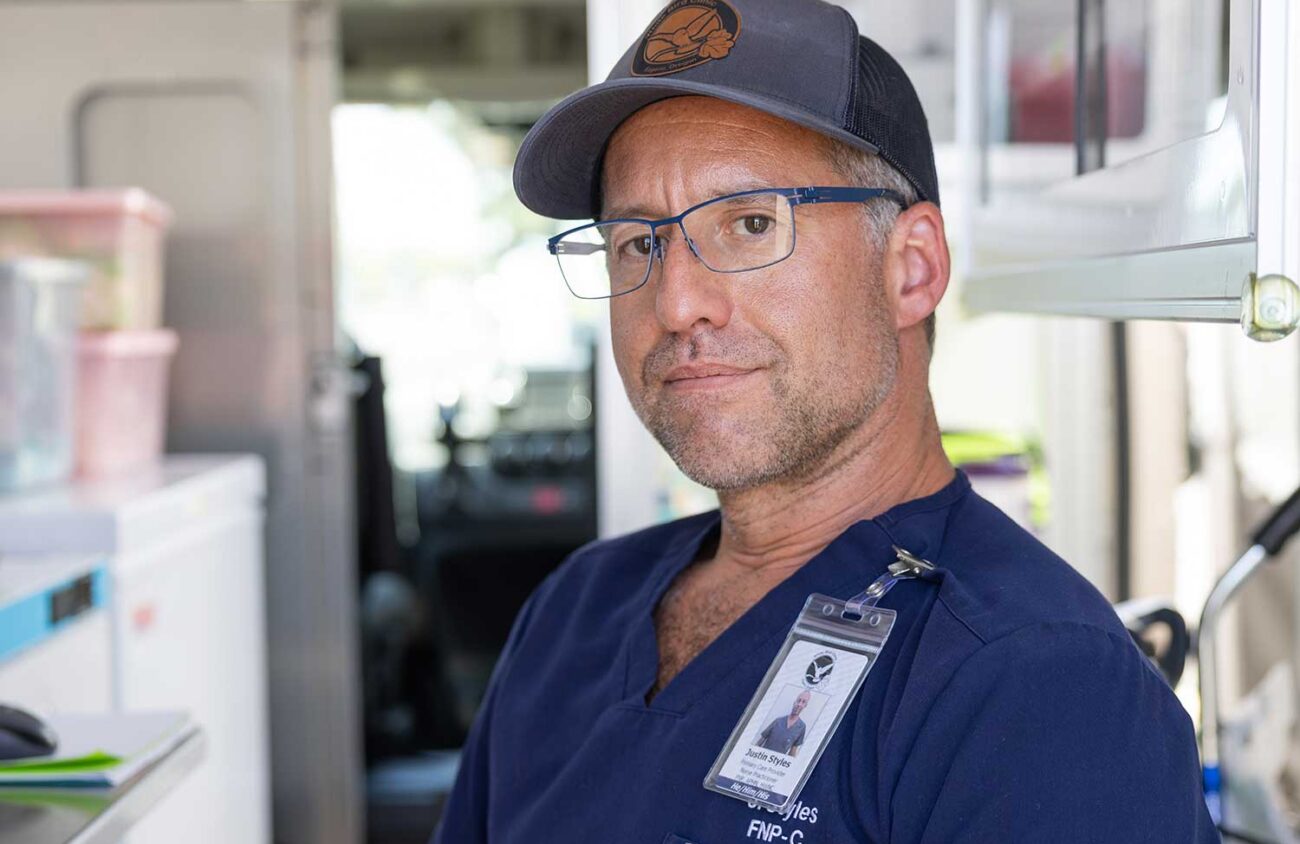
White Bird Clinic and ShelterCare are nonprofits that offer services ranging from primary care to case management. According to Justin Styles, a nurse practitioner and primary care provider with White Bird, the majority of cases he sees are an accumulation of health problems exacerbated by a lack of earlier intervention and psychosocial conditions such as drug or alcohol addiction.
White Bird partners with St. Vincent De Paul, Community Supported Shelters, and services and resources through Oregon Health Authority to approach care holistically, and provide one-stop shopping for all things medical, behavioral, and resources. It is adapting as more people seek out care from a shrinking resources pool.
The structure to provide health care for people experiencing homelessness does not start or end at the doctor’s office. It is a network of treatment that starts at meeting people where they’re at, Styles says. White Bird’s Mobile Clinic sets up at Eugene Service Station at St. Vincent De Paul on Fridays and at Community Supported Shelters on Tuesdays. This model was built on finding ways for homeless people to comfortably engage with treatment in an environment they’re familiar with.
“If somebody’s right then and they’re ready to engage, jumping on it right away and trying to get them going on services that could be supportive is critical because tomorrow they may not want to engage,” Styles says.
August Boyer works at the resource center right across the St. Vincent’s parking lot at Highway 99. She is a former case manager and helps people with Social Security. Throughout the week, White Bird, Oregon Department of Human Services, dental clinics, SquareOne Villages and Ko-kwel Wellness Center set up at different times, either in the center or out in the parking lot.
Housing is the ultimate step in this process, the basis for successful health and wellbeing, employment and stability.
In June 2026, the Oregon Attorney General and a coalition of states filed a federal lawsuit against the Department of Housing and Urban Development after it attempted to re-implement caps on funding and set restrictions on funds. According to a July 7 press release from the Oregon Department of Justice, this cap would evict tens of thousands of people. Without housing as a step in the process, Boyer says the demand for services will only keep increasing.
“We used to have a lot more funding,” Boyer says. “With all of the budget shortfalls and things like that, we lost all case management here especially, but all throughout the state.” A lot of her job is finding out ways to pay for the compounding costs of someone trying to get employment and housing, finding birth certificates and mitigating moving and transportation costs over time.
“We never turn anyone away,” Boyer says. “So we just need them where they’re at in the moment and try to help support them with what they’re willing to be in, you know, at any given time.”
A social worker at an hospital’s emergency department will refer an unhoused patient to an organization like ShelterCare after being treated. If White Bird or ShelterCare cannot meet a need, they almost always have a partner that can.
Everyone who walks up to the Mobile White Bird Clinic gets entered into an electronic health record. One of the main challenges of serving the unhoused is the amount of records floating in the abyss that indicate when someone was last seen.
KL, at 68 years old, has been homeless for the last 10 years. Eugene Weekly is keeping her anonymous due to safety concerns while living on the street alone. KL grew up in Eugene and went to North Eugene High School. After getting her secretarial degree and working in an office for 20 years, she transitioned to construction flagging. The company she worked for went under, and her only income for the past 15 years has been Social Security.
She lives in a tent at Dusk to Dawn on Highway 99 in Eugene, and came to the White Bird Clinic because she has a bunion the size of a quarter on the outside of her left foot. She says it has been bothering her for two years now. It’s the standing in line for every service that kills her.
KL is also in stage five kidney failure but is not able to get dialysis with her current living situation. Doctors cannot cut off the bunion due to her kidney problems, not to mention she doesn’t own any good shoes. Getting through every day is a struggle, she says.
Living in Eugene for so long, she’s known about White Bird for years.
“Seeing Justin over here on Friday,” she says. “He’s my doctor now.”
Kristen Raffin stood in the 80-degree heat leaning on one leg, the other swollen and tender. She had just signed up for access to a Conestoga Hut, a weather-proof micro-shelter provided by Community Supported Shelters, where she’s on an eight-month waitlist. In one hand is a black trash bag filled with instant mac and cheese packets for her friends.
“They’ve never steered me wrong,” Raffin says of White Bird’s Styles.
Raffin, a graduate of Crestwell High School, briefly moved to Colorado to study nursing. She was working at one of the biggest hospitals in Colorado in the oncology department, her mother called and said she had terminal cancer.
“I found myself in a bottle trying to cope,” she says.
She sees her peers experiencing infections and sickness every day.
“I like helping people. And I still do a lot of that, even being homeless. If somebody needs something, if I have an extra blanket, I’m going to give it to somebody. Or if I have extra food and they’re hungry, I’ll give it to them,” Raffin says.
On August 1, First Place Family Center opened. It is a resource center geared towards families. Leah Hess-Murray, St. Vinnies social services manager, says homeless families are a large enough problem to warrant the opening of the family center.
“Until we have more affordable housing, the reality is we’re going to have people that are homeless,” Hess-Murray says. “People who get Social Security checks, they cannot afford to pay the rents in this town”
She says Eugene is seeing more and more seniors on the streets. Vickey Haberstaat, ShelterCare program director,says time on the street ages people.
The Oregon Health Plan covers about 1.4 million Oregonians experiencing limited income. People without permanent addresses are able to apply for OHP. The Oregon Health Authority projects a $421 million budget shortfall in the biennial, meaning hundreds of thousands will lose access to health care.
“With all the changes that are coming our way, we can expect revenue loss,” says Amee Markwardt, White Bird executive director. “We can expect that our clients who struggle are going to struggle more with having to document that they’re working or volunteering. Even if they qualify for health care, maybe they’ll lose it because it’s hard to track deadlines and paperwork requirements.”
The resource center at Lindholm celebrated its one year anniversary in April.
“I’m always looking for other providers that want to come out and meet people where they are,” Hess-Murray says. “We want to keep growing it.”
Find White Bird Mobile Clinic at 450 Hwy 99, 9 am to noon and 1 pm to 3:30 pm Fridays, and at Community Supported Shelters at 2870 West 10th Place 9 am to noon and 1 pm to 3:30 pm Tuesdays. Visit White Bird Clinic’s website at WhiteBirdcCinic.org for more info. Go to SVDP.us for information on the Lindholm Social Services office and First Place Family Center.